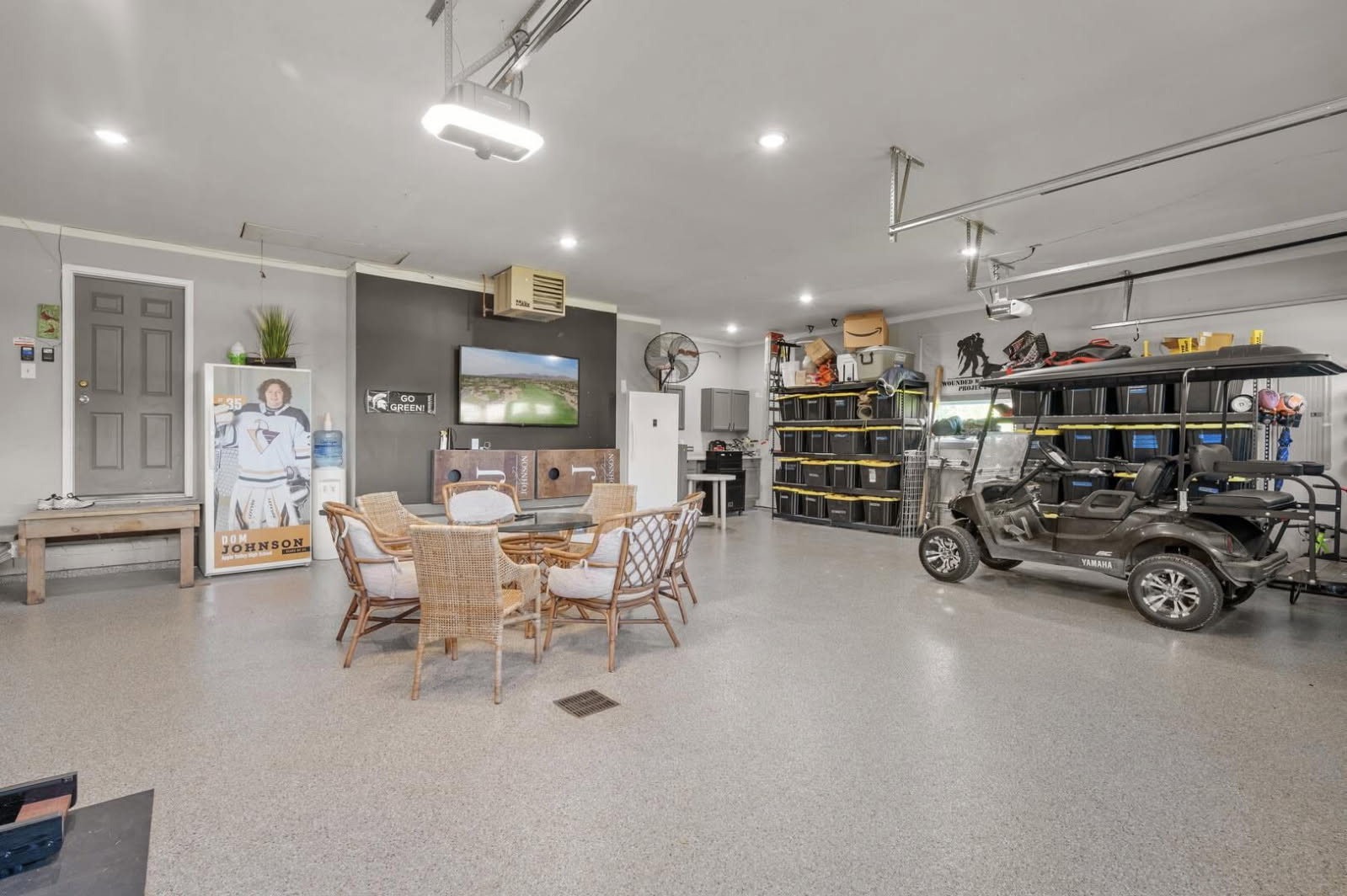
I get calls from serious hobbyists all the time — guys who've turned their basement into a real workshop. A lathe in one corner, a welding setup in another, a full woodworking bench, maybe a small machining area. They've built something they use every weekend, and they finally want to deal with the floor.
Good news: a basement workshop is one of the better applications for a polyurea flake coating. Near-zero VOC means it's safe to install and live with indoors, the chemistry stands up to solvents and oil, and the flake texture actually helps you find small parts when you drop them.
Why does VOC matter in a basement?
Basements don't ventilate well. Most have one or two small windows, a dehumidifier running in summer, and the HVAC return pulling air up into the rest of the house. Whatever goes into the air in your basement eventually ends up upstairs in the bedroom.
That's why I only use the Valence 100% solids polyurea system downstairs. It's near-zero VOC — basically no solvent to off-gas — so the install doesn't turn your house into a chemical cloud for a week. You can usually walk on it the next day and have tools back in place within 48 hours.
The old-school epoxy floors some contractors still install are full of solvent. I wouldn't put that in my own basement, so I don't put it in yours.
Does polyurea handle workshop chemicals?
Most of the stuff that ends up on a workshop floor is no problem for polyurea:
- Cutting oil and machining coolant — wipes up, no staining.
- Mineral spirits and paint thinner — fine for normal use, clean up spills reasonably soon.
- Gasoline and diesel — resistant, but don't leave a puddle for days.
- Welding spatter — this is the tricky one. Molten metal will burn a pit into any organic coating, including mine. More on this below.
- Wood stains and finishes — no problem.
- Battery acid — fine if cleaned up.
The polyaspartic topcoat is the wear layer doing most of the chemical resistance work. It's tough stuff, and it's what keeps the flake layer protected underneath.
What about the welding area?
Any coating is going to get damaged by welding spatter. I tell customers this up front so there's no surprise. A hot slag drop will burn a little crater into the polyaspartic, and it'll be visible.
There are two ways I handle this on a welding-heavy shop:
- Welding blanket or metal plate. Drop a fire-rated welding blanket or an old sheet of steel in the welding zone. Protects the coating and the blanket catches sparks.
- Sacrifice a zone. Accept that the welding corner is going to get some marks over time, and know that small damage can be spot-repaired later if it ever bothers you.
Everywhere else in the workshop the coating is going to last and look great.
Why flake instead of solid color?
Solid-color floors show every speck of dust, every drop of oil, every tool mark. Flake hides all of that between cleanings, and there's a second reason that matters in a workshop:
When you drop a 6-32 screw on a solid black floor, it vanishes. On a flake floor with light and dark chips, your eye has something to focus against and the screw shows up.
I'm not joking — customers tell me this is one of their favorite things about the floor after install. If you've ever been on your hands and knees with a flashlight looking for a set screw that rolled off the bench, you know.
You get to pick the flake blend. Lots of options, and I have a whole post on choosing flake colors that walks through it.
Does it handle basement moisture?
This is the question I always ask back: does your basement have a moisture problem right now? Because if the answer is yes — wet walls, efflorescence on the slab, standing water after a hard rain — we need to deal with that before any coating goes down.
Polyurea is not a waterproofing product. It's a wear surface. If water is pushing up through the slab from below, it'll lift any coating eventually, mine included.
For a dry basement — which is what most of my customers have — the coating actually helps with humidity control because it seals the concrete and stops it from sweating through. Dehumidifiers work better, the air feels less damp, and dust is drastically reduced.
For a basement with some historical moisture issues, I can do a moisture test before I quote and recommend a vapor barrier primer underneath the standard system. That's a conversation on the visit. Read more on my basement floor coating services page.
What does a basement workshop cost?
Basement workshops are residential-style pricing, not commercial, because they're inside the house and I use the residential warranty. Expect $7 to $12 per square foot depending on:
- Slab condition and crack repair
- How much stuff has to get moved out for prep
- Access — basement stairs make hauling grinders and material harder than a walkout garage
- Size of the space
A typical 400-600 square foot basement workshop is a one-day to two-day job, usually $4,000 to $8,000 all in. Comes with the 15-year residential warranty, not the commercial 5-year, because the load is completely different.
Is it worth doing?
If you actually use your basement workshop — if you're down there every weekend making stuff, not just storing boxes — the floor is one of those upgrades you notice every single time you walk in. It's easier to clean, easier to find parts, safer to move around, and it makes the whole space feel like a real shop instead of a concrete hole.
If you're in River Falls, Hudson, Woodbury, or anywhere in my service area, give me a call and I'll come take a look. I'll tell you straight what it'll cost and whether your basement is a good candidate.
Get a free quote or call Dave at (715) 307-8302.