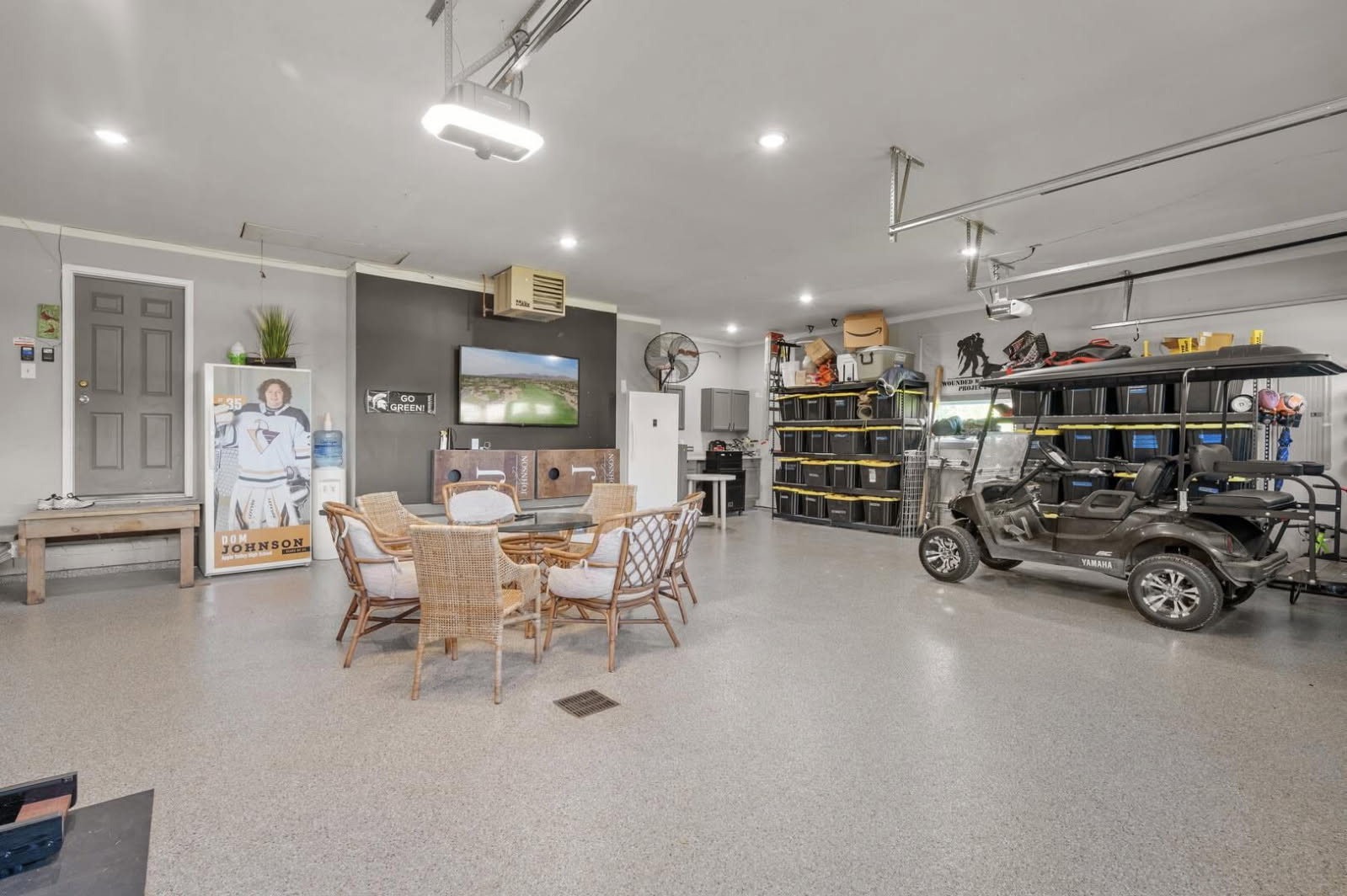
Short answer: yes, you can scratch a polyaspartic floor. The Valence Covalent Flake topcoat is about 4 times more abrasion resistant than epoxy per ASTM D4060, with a 674 PSI bond and 311% elongation, but it is not diamond. Drop a metal tool chest corner on it, drag a steel-wheeled cart across it, or push a loaded engine hoist without pads, and you can leave a mark.
This is one of those things where I would rather tell you the truth upfront than oversell the product and have you angry at me in a year. Here is what actually causes scratches, what does not, and what we can do about them.
What causes scratches on a coated floor?
In my experience, scratches almost always come from one of four things:
- Dragging heavy metal. Tool chests, safes, steel shelving, engine stands. The point load plus a hard edge plus motion equals a gouge.
- Steel-wheeled carts and jacks. Hard small wheels concentrate a lot of weight on a tiny contact patch. A steel-wheeled floor jack rolling over a piece of grit is the worst combo — the grit gets pressed into the topcoat.
- Dropped tools with sharp edges. A pry bar dropped on its tip, a chisel, the corner of a cast iron vice.
- Grit under a tire or pad. This is the sneaky one. A clean floor does not scratch. A floor with sand from winter under a rotating tire can get micro-scratches that show up as a dull swirl.
What does not scratch it in normal use: foot traffic, bike tires, car tires rolling straight, a broom, a mop, kids' toys, dog nails, plastic tote bins, a regular shop vac. Daily garage life is fine.
How tough is polyaspartic really?
The ASTM D4060 abrasion test measures how much material a standardized abrasive wheel grinds off after a set number of cycles. Polyaspartic at roughly 4x epoxy is not a marketing number — it is measured, repeatable, and it matches what I see in the field. Epoxy floors in busy shops wear through at the walking paths in a few years. Polyaspartic floors do not.
The 311% elongation number matters too. That is how far the coating can stretch before it tears. A flexible coating absorbs impact instead of chipping. A brittle epoxy with low elongation cracks when something hits it. Polyurea basecoat plus polyaspartic topcoat gives you both toughness and flex, which is why I use the system.
But — and here is where I differ from the guys who will tell you anything — flexible and tough does not mean scratch-proof. No clear coat is scratch-proof. Not on cars, not on phones, not on floors.
How to prevent scratches
Lift, do not drag
This is rule one. If it is heavy and has a hard bottom, lift it or put it on a furniture dolly with soft wheels. Tool chests especially — get rollers on them or use a pad underneath if you need to move it.
Put pads under feet
Any workbench leg, shelving foot, or cabinet that sits on the floor long term should have a felt pad or rubber foot. Cheap, takes 5 minutes, prevents a lot of headaches.
Use rubber or polyurethane wheels
Replace steel cart wheels with rubber or poly. Your floor jack probably already has rubber — check it and swap if not. The difference is huge.
Keep grit off the floor
Sweep regularly, especially after winter. Grit is what turns a harmless tire rotation into a scratch pattern. If you store the snowblower in the garage, hose off the scraper bar before it sits on the floor.
Mat under the tool chest
A small rubber mat or piece of carpet under a heavy rolling tool cabinet saves you from the one time you bump it and the corner slides.
What if I already scratched it?
Depends on the scratch.
Surface swirls or light scuffs: Often these are just marks on the surface, not actual topcoat damage. A scrub with a white pad and neutral cleaner usually makes them disappear.
Shallow scratch, no gouge: On a flake floor, shallow scratches hide in the flake texture surprisingly well. From standing height most are invisible. If one is bugging you, I can do a topcoat refresh in that area.
Deep gouge that shows the basecoat or concrete: This is a repair. The good news is that the Valence system is designed to be repairable. I can prep the damaged area, fill if needed, rebroadcast flake to match, and re-topcoat. It will not be invisible up close but from a few feet away it blends well. I do this as part of my warranty work when something legitimately fails, and as a paid touch-up when it is user damage.
Gouge plus impact crack in the concrete: Rare, but if you dropped something heavy enough to crack the slab, the coating telegraphs the crack. Now we are talking about concrete repair, not coating repair.
The 15-year warranty
My residential warranty is 15 years on adhesion and the coating system, plus a lifetime UV non-yellowing warranty on the polyaspartic. What that covers is the coating failing to do its job — delamination, bubbling, color fade. What it does not cover is you dropping a transmission on it. That is fair, and any installer who tells you otherwise is setting you up for a fight later.
Bottom line
Polyaspartic is the toughest clear floor coating I can buy. It handles real garage use without complaint. But it is a coating, not armor plate. Treat it reasonably, lift heavy things instead of dragging them, keep grit swept up, and it will look great for a long time. For more on how the system compares to the alternatives, see my post on polyurea versus epoxy.
Get a free quote or call Dave at (715) 307-8302.