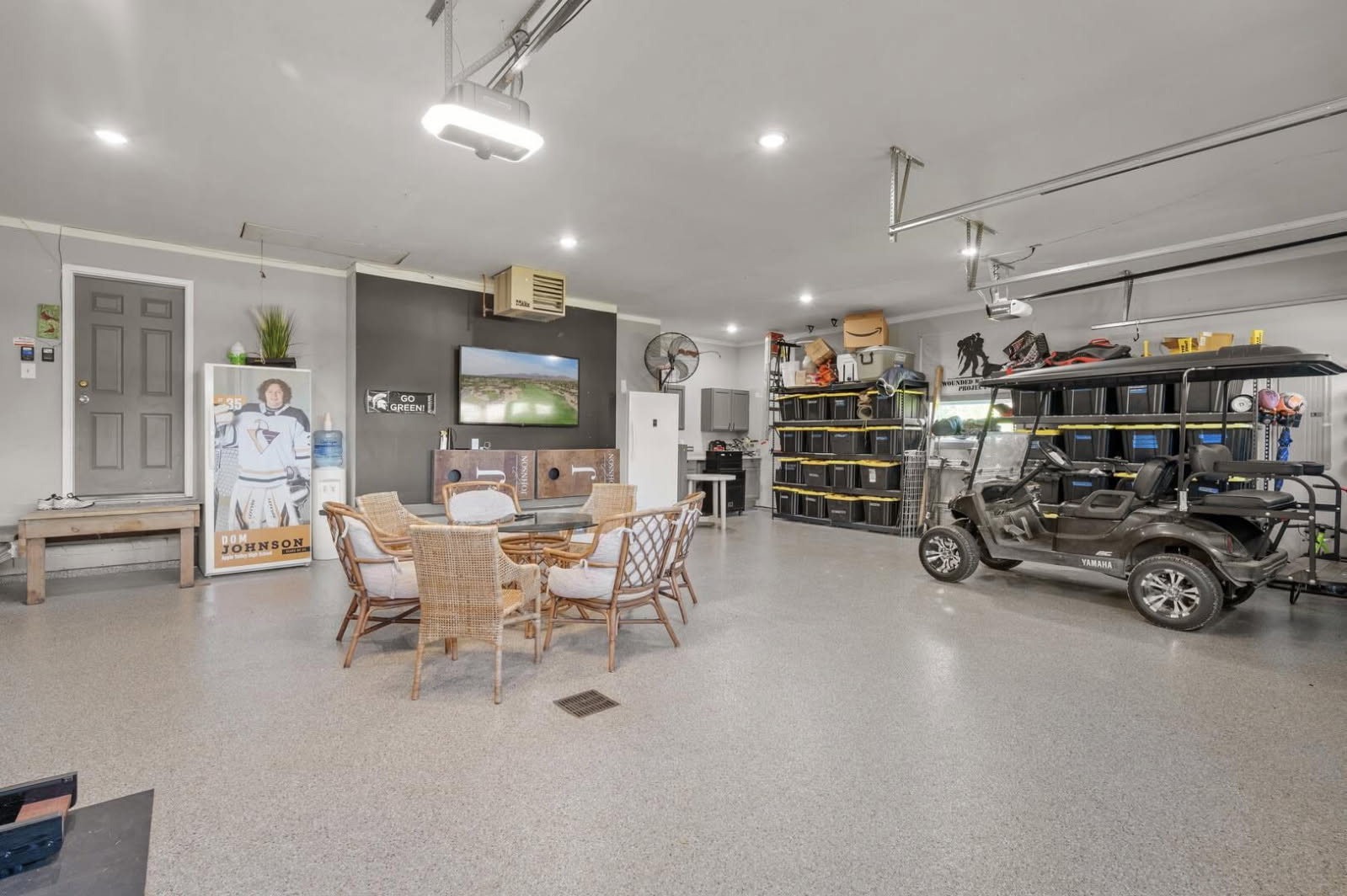
Commercial work is a big part of what I do. Auto shops, dog boarding facilities, small warehouses, breweries, and light manufacturing floors across the east Twin Cities metro. These are the businesses I know best because they need the same thing my residential customers need — a floor that works — but they need it on a schedule that doesn't shut them down. The Valence Covalent Flake System installs in one day and handles every kind of commercial abuse I've thrown at it. Here's how commercial jobs work.
Who Calls Me for Commercial Jobs?
Small business owners, mostly. The east metro is full of them:
- Independent auto shops in Woodbury, Oakdale, Cottage Grove, and Inver Grove Heights
- Dog boarding and grooming facilities that need floors they can hose down
- Breweries and taprooms in Stillwater, Hastings, and Hudson
- Small warehouses and distribution floors in the industrial pockets off 494 and 694
- Light manufacturing and fabrication shops
- Fitness studios and CrossFit gyms in strip-mall and industrial-conversion spaces
- Commercial kitchens and food prep spaces (where allowed)
What they all have in common is that downtime costs them money. A floor that takes a week to cure is a week they're not operating. Polyurea and polyaspartic cure fast — one day from grind to walkable, 24 hours to heavy traffic. That's the whole sell.
Why Polyurea for Commercial Floors?
Because it handles what epoxy can't:
- Chemical exposure — oil, antifreeze, brake fluid, brewing chemicals, cleaning agents
- Heavy abrasion — 4x the Taber resistance of epoxy
- Impact and flex — 311% elongation, handles dropped tools and rolling equipment
- Cold installs — polyaspartic cures down to 30 F, so I can install in unheated warehouses deeper into the year
- Bond strength — 674 PSI, pull tests fail the concrete before the coating
- UV stability — non-yellowing, crucial for spaces with skylights or bay doors
I've written a full epoxy vs polyurea comparison that's worth reading: polyurea vs epoxy. The short version: epoxy can't handle cold climate commercial floors. Polyurea can.
What Kinds of Commercial Jobs Have I Done?
A few recent examples from the east metro:
- An independent auto shop with heavy oil exposure — coated in one day, back to servicing cars 24 hours later
- A dog boarding facility that needed a floor it could hose and disinfect — full flake broadcast, textured topcoat for slip resistance
- A small brewery taproom with chemical exposure from cleaning cycles — polyurea handled it
- A fitness studio with rubber mats and dropped weights — the coating under the mats still looks new
- A fabrication shop with rolling equipment and jack stands — no visible wear after two years
What Does a Commercial Coating Cost?
Commercial jobs are priced by the job, not a flat residential per-foot rate, because prep requirements vary so much. A clean 2,000 sqft auto shop with a good slab is very different from a 5,000 sqft warehouse with joint problems and oil staining. That said, here's the ballpark:
- Small commercial (1,500-3,000 sqft): $10,000-$24,000 depending on prep
- Mid-size commercial (3,000-6,000 sqft): $22,000-$50,000
Every commercial quote is firm and in writing before I start. See my commercial floor coatings page for more. Prep for commercial jobs often includes degreasing, oil stain treatment, and joint repair in addition to the diamond grinding.
How Do I Keep You Operating During the Install?
One-day install is the answer. I show up early, grind with dust-collected diamond grinders so your space stays breathable, repair joints and cracks with TerraMend (cures -20 F to 130 F), lay polyurea basecoat, broadcast flake, topcoat with polyaspartic. Foot traffic that evening. Full service the next day.
For bigger jobs I can phase the install — grind and coat half the shop one day, the other half another day. I'll work around your schedule. Weekend installs are possible on commercial jobs when the space is closed. After-hours work too, depending on the job.
What's the Commercial Warranty?
5-year commercial warranty on the system, plus a lifetime UV fade warranty on the polyaspartic topcoat. UV stability matters even on indoor floors because of skylights, bay doors, and entryways. Epoxy yellows under UV. Polyaspartic doesn't. A properly installed Valence commercial floor should last well beyond the warranty period with only periodic cleaning as maintenance.
Moisture Testing for Commercial
I ASTM F1869 test every commercial slab. Threshold is 3 lbs per 1,000 sqft per 24 hours. Older industrial buildings without vapor barriers sometimes fail. If yours does, I'll tell you before I commit to coating. Moisture mitigation is available if needed, but it adds cost, and I'd rather you know up front.
Where Am I Working?
East metro mostly. Woodbury, Cottage Grove, Stillwater, Hastings, Inver Grove Heights, Eagan, Apple Valley, Lakeville, Oakdale, Lake Elmo, White Bear Lake, Forest Lake. I drive over from River Falls and I don't charge travel on these commercial jobs. If you're running a business in any of those towns, I can quote your floor.
I'm a Valence Certified Installer trained at their National Training Center in Eagan, and Valence is a Minnesota-based, woman-owned company I can recommend without hesitation. The product is made locally and the warranty has teeth.
Why Not a Big Epoxy Franchise?
Because I've seen what their floors look like after two winters in a Midwest commercial space. Epoxy in a commercial environment with freeze-thaw, salt, and chemical exposure is a losing battle. The franchises show up, install a product that works in Arizona, and disappear. When the floor fails, good luck getting a callback. I use a product built for this climate and I live 30 minutes from most of my east metro customers. If something ever goes wrong, I'm right here.
Let's Talk About Your Floor
If you run a small business in the east metro and your floor is due for an upgrade, call me. I'll come out, look at your slab, give you a written quote, and plan the install around your operating hours. Get a free quote or call Dave at (715) 307-8302.