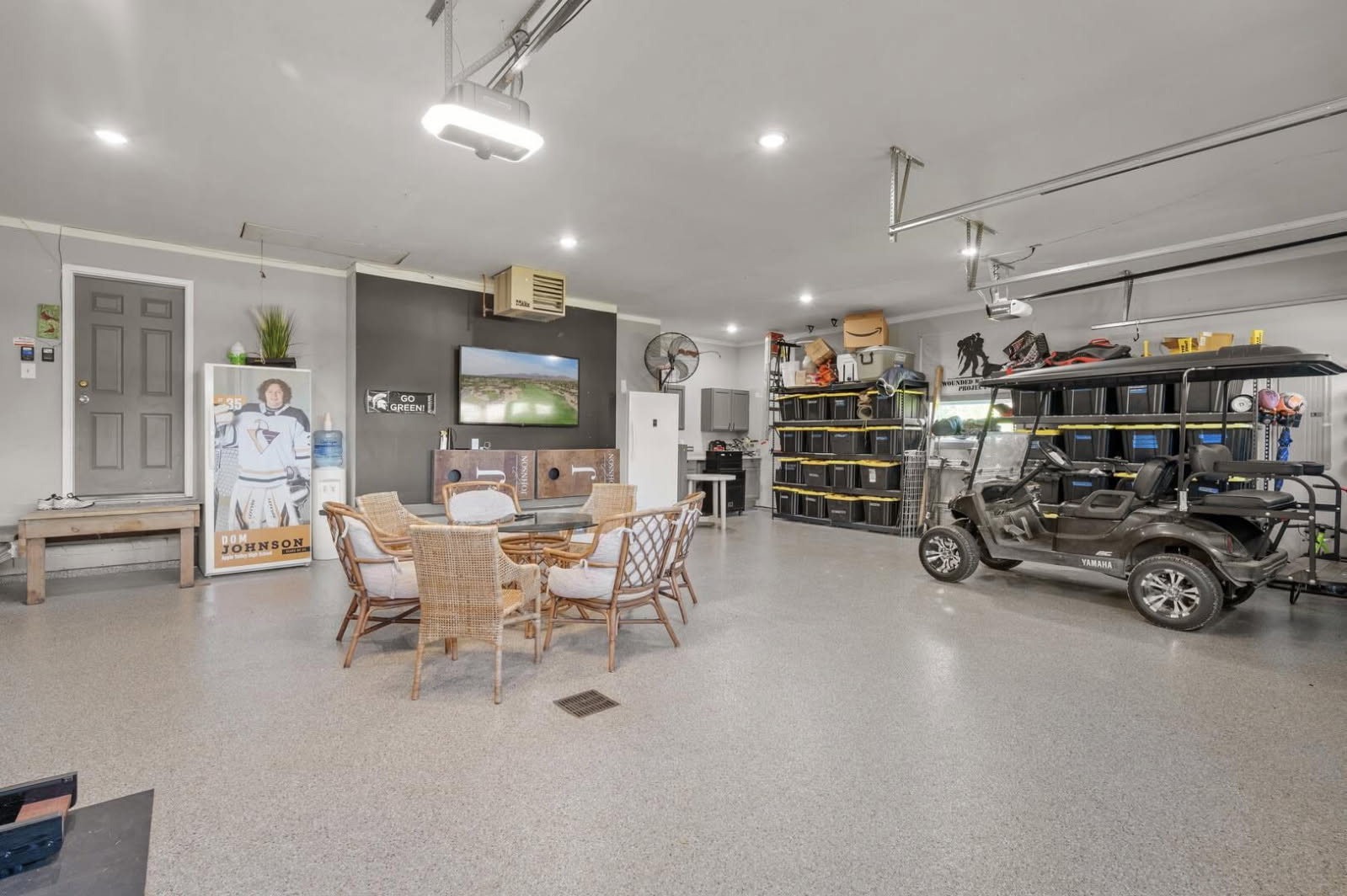
If you take one thing away from this post, take this: 80% of floor coating failures come from bad surface prep. Not bad product, not bad weather, not bad luck. Bad prep. And in my shop, that means we diamond grind every single floor before a drop of coating touches it. I don't acid etch. I've never met a floor that acid etching prepped well enough for a professional polyurea system, and I've looked at a lot of them.
Homeowners ask me about this all the time because the DIY kits at the big box store come with a bottle of etcher and tell you it's good enough. It's not. The kits are designed around the cheapest possible prep because the manufacturer knows the average buyer isn't going to rent a grinder. Let me walk you through why the prep step matters so much, what CSP actually means, and why the machine on the back of my trailer is the most expensive part of the job.
What is CSP and why does it matter?
CSP stands for Concrete Surface Profile. It's a standard from the International Concrete Repair Institute that measures how rough the surface of a slab is on a scale from CSP 1 (smooth, like a troweled finish) up to CSP 9 (aggressive chipping, like scarifying). Coating manufacturers specify a CSP range for their product because the coating needs a certain amount of tooth to grab onto.
The Valence Covalent Flake System I install calls for CSP 2 to 3. That's the industry standard for polyurea and polyaspartic coatings. It means the surface looks and feels like fine to medium sandpaper. Deep enough that the coating keys into the pores of the concrete and bonds mechanically, not just chemically.
At CSP 2-3, Valence hits a 674 PSI bond strength on the pull test. That's tearing concrete out of the slab before the coating lets go. You can't get that with a weak profile.
How does diamond grinding work?
A diamond grinder is a walk-behind machine with rotating heads holding diamond-segmented tooling. It shaves off the top layer of the slab along with any contamination, old sealer, laitance, or weak surface paste. What's left behind is sound concrete with an open, consistent profile.
A few things diamond grinding does that nothing else can:
- Removes contamination deep. Oil, grease, old sealer, paint overspray. Not just from the surface but from the top couple millimeters where it's soaked in.
- Opens the pores evenly. The whole floor gets the same profile. No dead spots, no over-etched pits.
- Flattens high spots. Trowel marks, control joint shoulders, little bumps from pour day. All gone.
- Produces dry dust, not slurry. I run a HEPA vacuum on the grinder so your garage isn't a mud pit at the end of the day.
What's wrong with acid etching?
Acid etching uses muriatic acid (hydrochloric acid) diluted with water to chemically eat the surface of the concrete. Sounds reasonable on paper. In practice, it fails on three fronts:
1. It doesn't remove oil consistently. Muriatic acid reacts with the calcium in concrete, not with petroleum. If your garage has any oil staining at all, and most do after a few years of parking a vehicle on bare concrete, the acid just beads up and does nothing in those spots. You get hot tire pickup and delamination right where the oil was.
2. It doesn't open the pores deep enough. On a hard-troweled slab, acid etch gets you maybe a CSP 1, if you're lucky and you scrub it hard. That's not enough tooth for a polyurea system. The coating sits on top instead of keying in.
3. It leaves residue. Acid etching creates calcium chloride salts as a byproduct. If you don't rinse and neutralize perfectly, and I mean perfectly, those salts stay on the surface and sabotage the bond from day one. Most DIYers don't even know to neutralize.
I've seen floors that were acid etched and coated by another contractor show up on my estimate calendar eight months later, already peeling in sheets. Every time, it traces back to prep.
What about shot blasting?
Shot blasting is another mechanical prep method and it's a legitimate option on big commercial floors. Steel shot gets thrown at the slab and rebounds into a vacuum. It's fast on wide open warehouses. For residential garages and basements though, diamond grinding is a better fit. It gets right up to the walls, handles control joints cleanly, and gives a more uniform profile on smaller floors.
What does grinding a floor actually look like on install day?
When I roll into a garage, the grinder comes out first. I work the main field of the floor with the walk-behind, then switch to a hand grinder for the edges, corners, and the apron in front of the door. Between the machine and the vacuum there's some noise, but almost no airborne dust.
After grinding, I run a drop light across the slab at a low angle and look for anything I missed. Glossy patches mean there's still something sealing the pores. If I see one, I hit it again. Then I fill cracks with TerraMend 100% solids polyurea, grind the patches flush, and the floor is ready for base coat.
You can read more about how we handle the rest of the day in what to expect on installation day, but prep is always the first two hours and it's the most important two hours of the whole job.
So what should you ask a contractor?
If you're shopping quotes, ask every contractor this one question: how do you prep the slab? If they say acid etching, walk away. If they say "we scuff it with a buffer and a screen," same answer. If they say diamond grinding to CSP 2-3, they're speaking the language of a real coating system.
Prep is invisible once the flake goes down. That's why cut-rate contractors skip it. I grind every floor because I don't want callbacks, and I don't want my name on a floor that's peeling in a year. You can see some of the prep work and finished jobs in our gallery, or read more about our surface prep process.
Questions about your floor? Get a free quote or call Dave at (715) 307-8302.