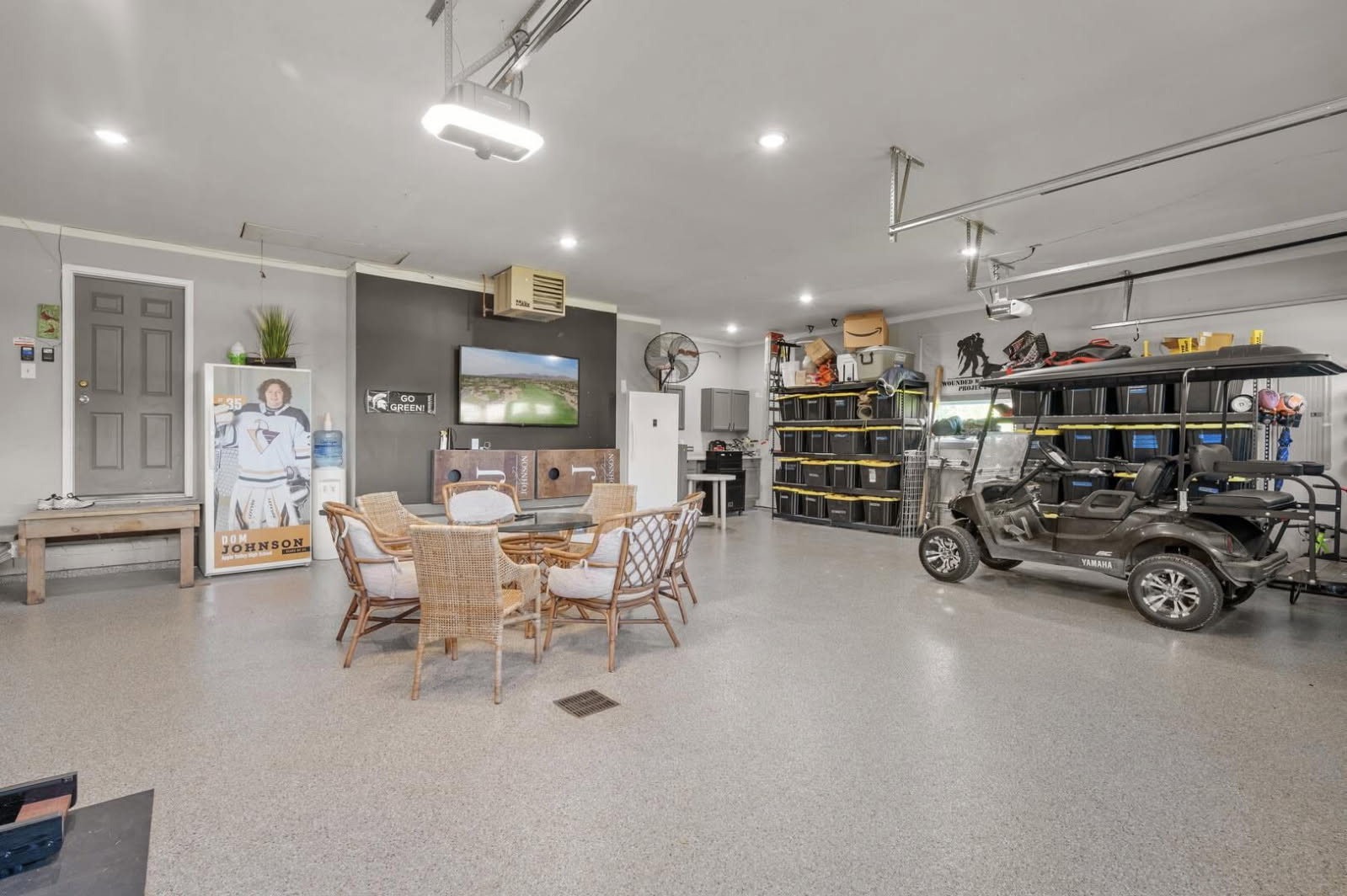
I'm going to tell you something most coating guys won't: not every concrete floor should be coated. Some slabs are too far gone, and putting a beautiful flake finish over a broken slab is lipstick on a cracked pig. I've walked away from jobs where the right answer was "repour this, don't coat it." Here's how I decide.
The quick rule
A coating is a wear surface. It protects concrete from oil, chemicals, hot tires, moisture, and abuse. It is not a structural repair. If your slab has structural problems, no coating on earth will fix them. The coating will telegraph every crack, every sunken section, and every bit of movement right up through the flake.
That's the rule. Now let's get into what "structural problems" actually means.
Sign 1: Deep structural cracks
Hairline cracks? Totally normal. Every slab has them. I route them out and fill them with TerraMend 100% solids polyurea crack repair, which cures flexible from -20 degrees up to 130 degrees Fahrenheit and moves with the slab. No issue at all.
But I'm talking about the other kind:
- Cracks wider than a quarter inch
- Cracks where one side is higher than the other (vertical displacement)
- Cracks that run edge to edge across the slab
- Cracks that open and close with the seasons because the slab is still moving
Those are signs of structural movement, either from a footing issue, freeze heave, or a slab that was poured without proper base prep. A coating over an actively moving crack will split at that crack within a year. Guaranteed.
Sign 2: Major spalling or scaling
Spalling is when the top surface of the concrete flakes, pops out, or scales off. A little bit of it is fixable. I'll get into the process for that in another post on fixing spalling concrete before coating.
But when spalling covers more than about 25% of the slab, or when the pop-outs are half an inch deep or deeper, you're looking at a floor where the top inch of concrete is basically shot. At that point, repairing it piece by piece costs more than a skim coat or a full repour, and the end result still isn't as good.
If I see deep, widespread scaling from years of road salt tracked in on car tires without any sealer, I'll tell you honestly: this floor wants a grind and a skim coat repour more than it wants a coating.
Sign 3: Sinking or heaved slabs
Stand at one corner of your garage and look across the floor with one eye low to the ground. If you can see the slab dip in the middle, or one panel sitting an inch lower than the next, you've got a settling problem. Usually it's from soil washout under the slab, poor compaction on the original pour, or a leaking downspout dumping water next to the foundation.
A coating does nothing for that. It'll cover the visual but the low spot is still there, water still pools in it, and the settling may still be happening. What you need first is slabjacking (also called mudjacking or foam jacking), which lifts the slab back into position by pumping a slurry or polyurethane foam under it. Once it's level and stable, then we can talk about a coating.
I don't do slabjacking myself, and I'll tell you to call a specialist for it. That's the honest answer.
Sign 4: Standing water after a rain
Related but different: if your garage floor puddles up every time it rains and holds water for hours, the slope is wrong. Either the original pour wasn't graded right, or the slab has settled. A coating doesn't change the slope. You'll still have a puddle, it'll just be a prettier puddle.
For a commercial floor, I can sometimes build a subtle slope correction with self-leveler before the coating goes down. For a residential garage that's dramatically off, it usually isn't worth it.
Sign 5: Failed moisture tests
I covered this in detail in moisture testing and MVER, but it belongs on this list. If your slab is pushing vapor at more than 3 pounds per 1,000 square feet per 24 hours and no mitigation is practical, the floor isn't ready for a coating. Fix the drainage or fix the vapor barrier first.
Sign 6: Previous coatings that failed catastrophically
If you've got a DIY epoxy that peeled in sheets, a big box store kit that never really bonded, or an old garage paint job that's lifting everywhere, that's not necessarily a death sentence. Diamond grinding removes almost all of it, and we'll have more on that in the upcoming post on dealing with old sealers and coatings.
The case where it is a problem is when the previous coating failed because the concrete underneath was bad. If the old coating pulled chunks of concrete with it when it peeled, the slab is laminating, the top surface has no integrity, and no amount of prep gets you back to sound concrete without going too deep.
When is it still worth coating?
Most floors I look at are fine. Dirty, maybe. Stained, probably. A few cracks and a pitted spot or two. That's a normal garage slab and it coats up beautifully. The stuff on this list is the exception, not the rule.
Here's what I do at every estimate:
- Walk the whole floor with a drop light
- Check for structural cracks, spalling, sinking, and standing water lines
- Run a calcium chloride moisture test
- Put a straightedge across suspect areas to check for settling
- Give you an honest yes, no, or "fix this first, then call me back"
I'd rather send you to a slabjacker or a concrete contractor and lose the job than coat a floor I know is going to embarrass me in a year.
If you're not sure what you're looking at, send me a couple photos. I can usually tell from a phone picture whether your floor is a candidate for a coating or whether it needs something else first. Take a look at the garage floor coatings page for the kinds of floors we do install.
Got a questionable slab? Get a free quote or call Dave at (715) 307-8302.