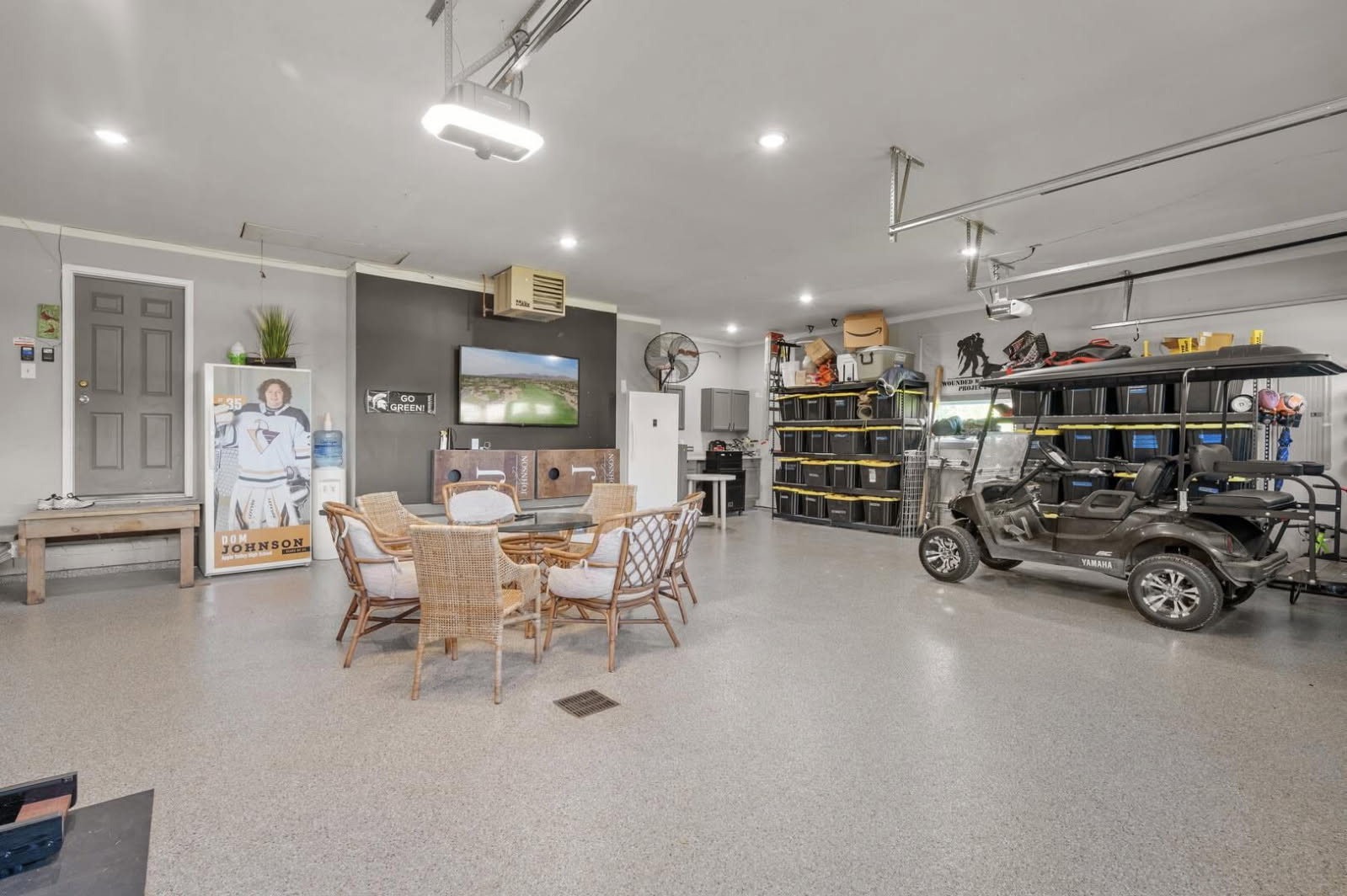
You spent a Saturday prepping and rolling out a $300 epoxy kit from the hardware store. Six months later, you're staring at peeling patches where your tires park and a yellowish haze creeping across the floor. You're not alone. Industry data puts the failure rate of DIY garage floor epoxy kits at roughly 30% within the first two years. That's nearly one in three floors coming apart before they're even broken in.
Here's what went wrong — and what actually fixes it for good.
Why Do DIY Epoxy Garage Floor Kits Fail?
About 80% of all epoxy coating failures stem from improper surface preparation. That's the single biggest factor, and it's the one DIY kits handle worst. Those kits tell you to acid-etch your concrete with a jug of muriatic acid. Acid etching is unreliable — it doesn't remove oil and contaminants consistently, it can't open concrete pores deep enough for a real mechanical bond, and it leaves chemical residue that actually interferes with adhesion.
Professional diamond grinding creates a CSP 2-3 surface profile — the industry standard for polyurea adhesion. It removes the weak surface layer of concrete (laitance), eliminates contaminants, and opens every pore. No DIY kit includes a professional diamond grinder. That's not a marketing upsell — it's why the coating sticks or doesn't.
What Is Hot Tire Pickup and Why Does It Destroy Epoxy?
Your car's tires reach 140°F or higher in summer driving. When you park on an epoxy floor, that heat softens the coating past its glass transition temperature. As the tire cools overnight, it bonds to the tacky epoxy. When you back out the next morning, the epoxy peels right off the concrete — stuck to your tire rubber. This is called hot tire pickup, and it's a documented, well-known failure mode that affects every epoxy floor eventually. It's not a defect. It's the chemistry.
Why Does DIY Epoxy Turn Yellow?
Epoxy is not UV stable. Open your garage door on a sunny afternoon and UV exposure starts degrading the finish immediately. Within 6-12 months, that crystal-clear coat turns amber, then chalky. South- and west-facing garages go faster. No amount of "UV-resistant" language on the box changes the underlying polymer chemistry. Polyaspartic topcoats, by contrast, are genuinely UV stable and non-yellowing — which is why we use them as the final layer in our Covalent Flake System.
Does DIY Epoxy Actually Save Money?
A DIY kit costs $100-500 in materials — call it $2-5 per square foot. Sounds cheap next to professional coating. But run the real numbers: a $300 kit that fails in 18 months costs about $200 per year. A professional polyurea floor coating at $7-9 per square foot with a 15-year warranty costs roughly $120-150 per year — and you never touch it again. No re-do weekends, no sore knees, no peeling to stare at.
Professional coating is cheaper per year. Every time.
What Coating System Actually Works on a Garage Floor?
Polyurea and polyaspartic coatings fix every problem that kills DIY epoxy:
- No hot tire pickup: Polyurea doesn't soften at tire temperatures. Park all day, every day — it won't budge.
- UV stable: Polyaspartic topcoats don't yellow or chalk. The Valence topcoat we use is 85% solids, non-yellowing, and backed by a 15-year warranty.
- 311% elongation: Polyurea flexes with your concrete through Wisconsin's 100+ freeze-thaw cycles per year without cracking or delaminating. Epoxy is rigid and can't keep up.
- 674 PSI bond strength: Pull tests show our polyurea basecoat bonds so well that the concrete substrate fails at 400-500 PSI before the coating lets go. That's substrate failure — the concrete breaks before our coating does.
Can a Failed DIY Epoxy Floor Be Fixed?
Yes, but not by rolling another coat on top. The failed epoxy needs to be completely removed by diamond grinding before a proper system goes down. We do this regularly — a significant portion of our jobs are replacing failed DIY and contractor epoxy. Dave grinds off the old coating, repairs cracks with TerraMend polyurea filler, and installs a full polyurea system that actually lasts. It's a one-day job.
Stop throwing weekends and money at a product that doesn't work. Get a free quote or call Dave directly at (715) 307-8302 for a floor that's done right — once.