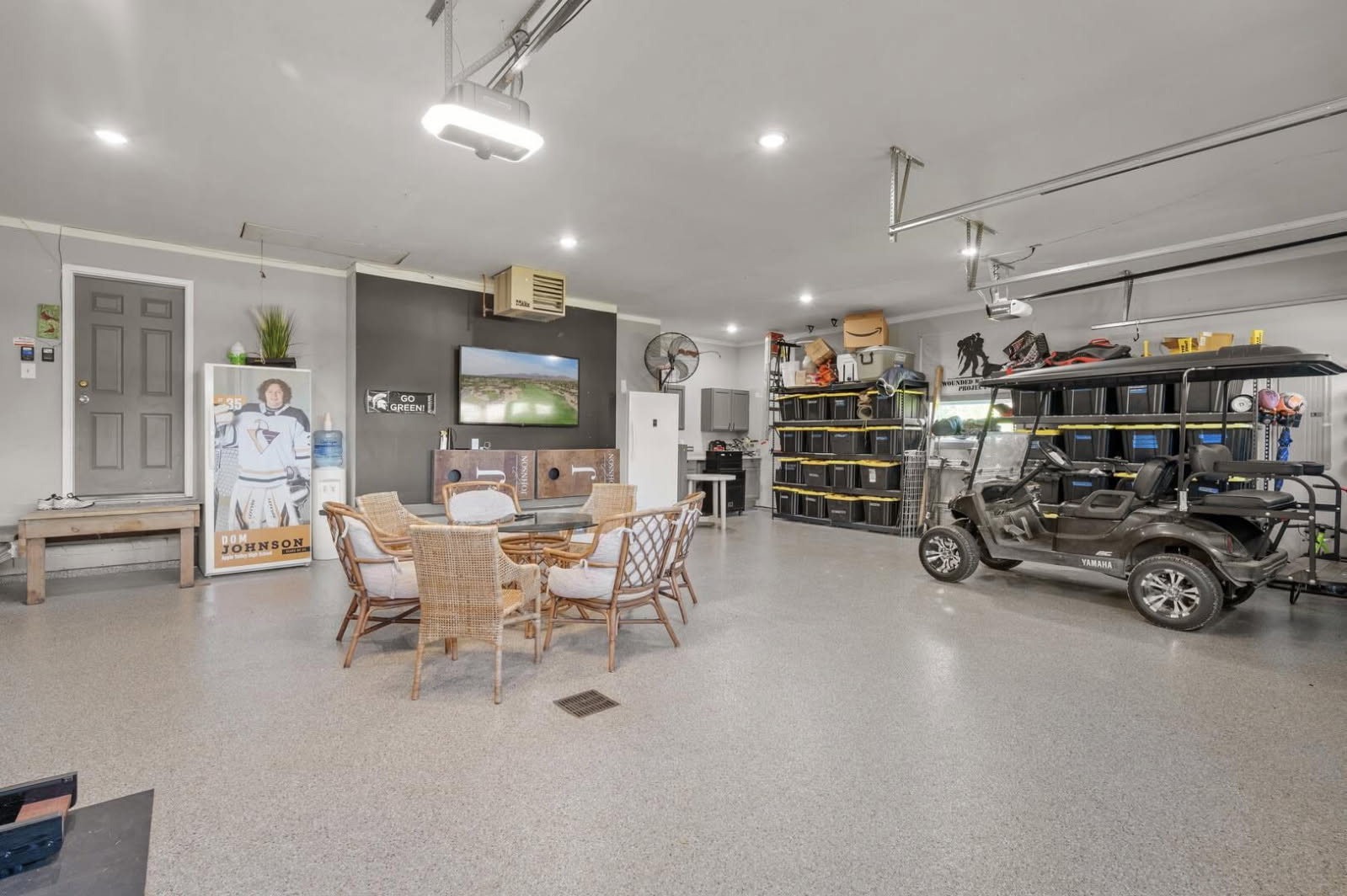
Every winter in Wisconsin, your car drives through salt, slush, and calcium chloride brine on the highway, then parks in your garage and drips it all over the slab. You look at the white crust on the floor and think it's just messy. It isn't just messy. That puddle is actively eating your concrete from the inside out, and the damage accelerates every year you leave the floor uncoated.
I'm Dave. I run All American Concrete Coating out of River Falls and I've ground and repaired more salt-damaged slabs than I can count. Here's what's actually happening under your car, and why I push homeowners to get coated before the slab is too far gone to save cheaply.
What does road salt actually do to concrete?
Concrete looks solid but it's porous. Microscopic capillaries run all through a slab, and water gets into them. When you track salt-laden slush into the garage, a few things kick off at once.
- Chloride penetration. The dissolved salt rides the water deep into the concrete. It doesn't sit on the surface. It travels.
- Lowered freeze point. The salt-water mix inside the slab freezes at a different temperature than pure water, which means the slab can cycle through freeze-thaw more times per winter than it otherwise would.
- Scaling and spalling. As ice forms and melts inside the capillaries, it pries the concrete apart from the inside. You see it as flakes on the surface. Those flakes are the top of a much bigger problem.
- Pop-outs. Small pieces of aggregate get pushed out from below as trapped moisture expands. Once you see pop-outs, the freeze-thaw cycle is already deep in the slab.
- Rebar corrosion. If your slab has rebar or wire mesh, chloride reaching that steel starts oxidation. Rust occupies more volume than steel, so it pushes outward and cracks the concrete from inside. This is the worst version of the damage because you can't see it until the slab is already failing.
Why is Wisconsin worse than most places for this?
Because we get the full combination. We see over 100 freeze-thaw cycles per year in western Wisconsin, more than almost any comparable climate. Then we add sodium chloride (rock salt), calcium chloride, and magnesium chloride to every road surface from November through March. Then drivers track all of it into attached garages that are warmer than outside, so the slush melts and sits on the slab instead of bouncing off frozen.
Your garage floor gets the worst of every world: the chemicals, the thermal cycling, and the water. A rural driveway in Arizona will never see what your River Falls slab sees in a single February.
How fast does uncoated concrete actually degrade?
Faster than homeowners think, and the degradation is not linear. It's an accelerating curve.
The first few winters, you see staining and maybe a little scaling. Annoying but cosmetic. Around years five to ten, if you haven't sealed or coated, you start seeing real surface loss. Spall patches where chunks come up. Pop-outs that catch a shop vac wheel. Hairline cracks spreading into wider cracks as freeze-thaw opens them up.
By the time a slab is visibly deteriorating, the chloride is already deep. You can still coat it, but the prep and repair work gets more involved. Instead of a clean grind and a basecoat, we're looking at TerraMend crack and pit repair across large sections, sometimes full crack routing and fill.
Salt damage is one of those problems where waiting one more winter is almost always the wrong call. Every winter compounds.
Does the Valence system actually stop salt damage?
Yes, and this is why I switched to it. The polyurea basecoat in the Covalent Flake System is chemically resistant to sodium chloride, calcium chloride, and magnesium chloride. That covers every common road salt and brine used on Wisconsin roads. It bonds to the concrete at 674 PSI and flexes with 311% elongation, so thermal cycling doesn't crack it off.
Once the slab is coated:
- Salt water sits on top of the coating, not inside the concrete.
- You squeegee or hose it out instead of letting it soak in.
- Chlorides never reach the rebar.
- Freeze-thaw has nothing to push on, because there's no open capillary network at the surface.
That's the whole case for coating. It's not about looks, even though the floor looks great. It's about stopping the chemical and mechanical attack that a Wisconsin winter runs on bare concrete every year.
Is it too late to coat my old salt-damaged floor?
Probably not, but the answer depends on how deep the damage is.
If your floor has surface scaling, pop-outs, and cracks, I can usually prep and coat it. TerraMend fills cracks and pits, I grind the surface clean of loose material, and the Valence system goes down over a sound base. The only slabs I turn away are the ones with structural failure all the way through, and those are rare in a typical residential garage.
What I need to do on your visit:
- Walk the floor and grade the damage honestly.
- Check for moisture issues (freeze-thaw often comes with drainage problems).
- Identify any sections where prep will take extra time.
- Give you a straight number.
What does salt damage actually cost over time?
Homeowners ask me to compare the cost of doing nothing to the cost of a coating. Here's the honest picture.
Doing nothing costs you on two fronts. First, your slab keeps degrading. Surface repairs start becoming necessary around the 8-to-15 year mark on an uncoated, salt-exposed residential garage in Wisconsin. Patching, resurfacing, or in some cases replacing sections gets expensive. Second, when you finally do decide to coat, the prep cost is higher because you're starting from a worse slab. I might need multiple hours of extra grinding, TerraMend fill across large sections, and careful diagnosis of how deep the damage goes.
Doing it now, on a slab that's starting to show salt wear but isn't gone yet, is the cheapest version of this project you'll get. That's not a sales line, it's just how the math works.
Is there anything I can do short of coating?
You can rinse the slab down regularly through winter to knock the salt off before it penetrates. You can squeegee standing meltwater out the door. Both help slow the damage, neither stops it. Penetrating sealers give you some protection but they don't last, they don't handle hot tire pickup, and they don't give you a surface you can clean the way a coated floor cleans. For a real long-term answer, a coated floor is the only option I trust, and it's the only thing I install.
When should I call?
Before next winter if you can. The spring and early fall windows are my best install times, and booking ahead gets you a slot before my calendar fills. If your floor is actively flaking right now, don't wait the whole year. Get me out for a quote and we'll figure out the right timing.
Salt is going to keep coming off your tires. The only question is whether it's eating your slab or running off a coating you can hose clean.
Get a free quote or call Dave at (715) 307-8302.