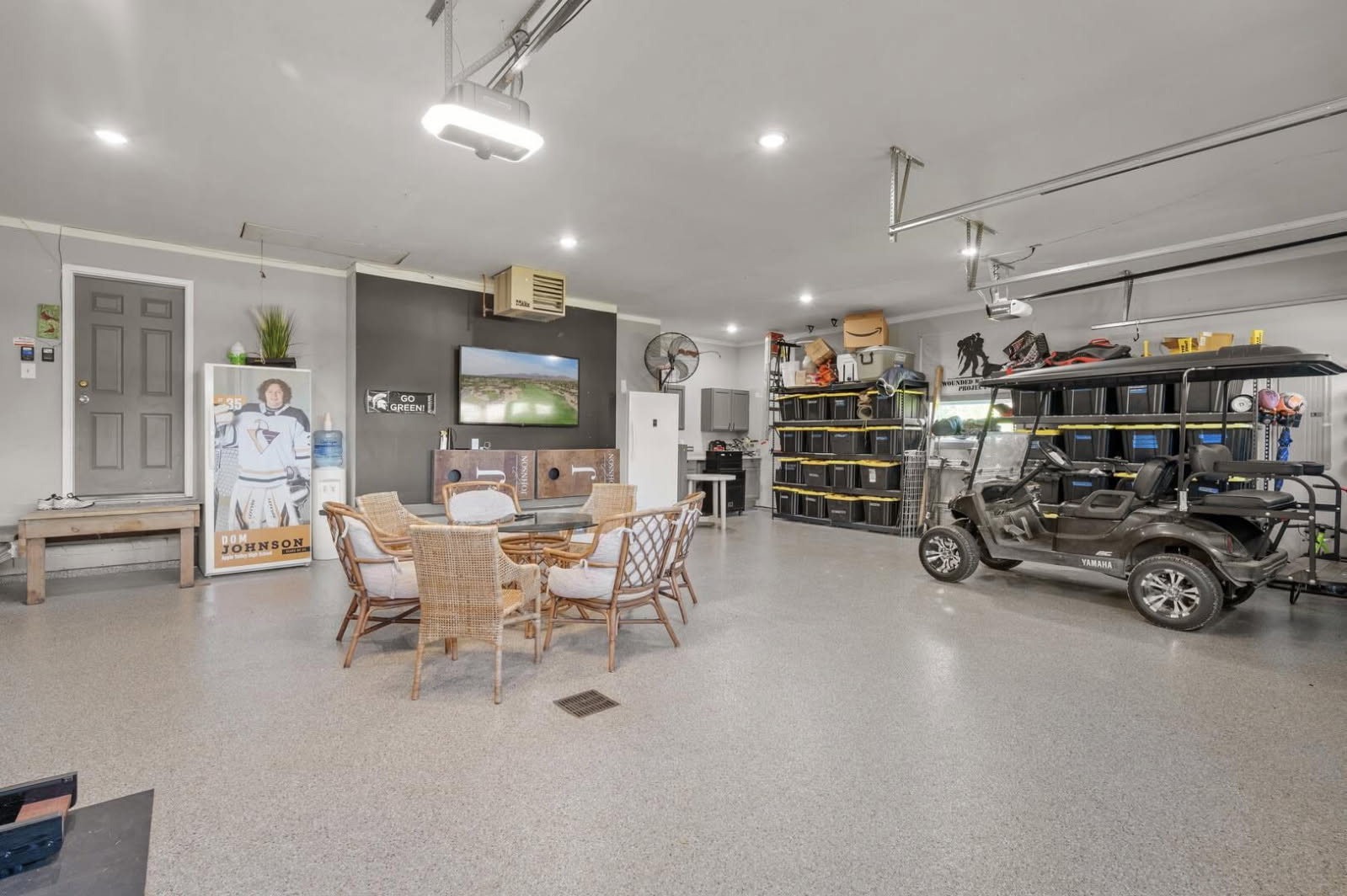
New Richmond is one of my favorite areas to work in. It's the rural-suburban mix that western Wisconsin does best: working farms, hobby farms, pole barns, shop garages, and newer subdivisions mixed into the same zip code. Most of my New Richmond jobs are workshop floors and pole barn slabs, not just attached garages, and polyurea is the only coating I'd trust for any of it. Here's what New Richmond and St. Croix County homeowners should know.
Why Polyurea for New Richmond Workshops?
Because New Richmond customers use their floors. I'm not coating a showpiece garage that parks a Tesla. I'm coating floors where tractors, skid steers, Bobcats, F-350s, and shop equipment actually work. Those floors get:
- Steel tools dragged across them
- Hydraulic oil dropped on them
- Jack stands set on them
- Welding sparks hit them
- Salt and mud from farm equipment tracked onto them
- Chains and winches rolled across them
Epoxy can't handle that. Polyurea can. The Valence Covalent Flake System has 4x the abrasion resistance of epoxy on the Taber test, a 674 PSI bond strength that breaks concrete before it lets go, and 311% elongation that flexes through Wisconsin's 100+ freeze-thaw cycles a year. Those aren't marketing numbers. Those are ASTM test results.
What Kinds of Buildings Am I Coating?
All over New Richmond and the surrounding St. Croix County:
- Pole barns and shops on rural properties north and east of town
- Attached garages in the newer subdivisions on the south end
- Detached workshops behind older farmhouses
- Small commercial — auto shops, equipment repair, feed facilities
- Hobby shops and man caves in converted pole buildings
Pole barn floors are usually bigger — 1,200 to 2,400 square feet is common — and the slabs vary wildly in quality. Some are textbook pours with vapor barriers and rebar. Others are 40 years old with no vapor barrier and cracks from frost heave. I evaluate every one before I quote.
What Does a Polyurea Coating Cost in New Richmond?
Residential work is $7-$9 per square foot. Pole barn and commercial work is quoted by the job based on square footage, prep needs, and whether the slab needs leveling or crack repair. A 2-car attached garage runs $2,800-$4,500. A 1,500 sqft pole barn will typically run $9,000-$13,000 depending on prep. For more context, see my WI cost guide.
I quote New Richmond jobs at my standard rate — it's a 25-minute drive from my River Falls shop, no travel upcharge. If you're farther out toward Glenwood City or Clear Lake, I can still work your job but I'll tell you if I need to batch it with another nearby install to make the drive work.
What System Goes On the Floor?
The Valence Covalent Flake System, installed in one day:
- Diamond grind to CSP 2-3 profile
- Crack repair with TerraMend (cures -20 F to 130 F)
- 100% solids polyurea basecoat
- Full vinyl flake broadcast
- 85% solids polyaspartic topcoat, UV stable, non-yellowing
It comes with a 15-year residential warranty and a 5-year commercial warranty. Lifetime UV fade warranty on the topcoat. Valence is a woman-owned company in Mendota Heights MN, and I'm a Certified Installer trained at their National Training Center in Eagan.
Can You Coat in Winter?
Yes, as long as the building is enclosed and I can hold the slab above 30 degrees F. For heated pole barns, that's easy. For unheated ones, I schedule around weather windows in fall and spring. Polyaspartic applies down to 30 F, which beats epoxy's 50 F minimum by 20 degrees — a huge deal in Wisconsin where the install season for epoxy contractors is effectively May through September. See my cold climate post for more.
Moisture Tests on Pole Barns
I run an ASTM F1869 moisture test on every pole barn floor I quote. The threshold is 3 lbs per 1,000 sqft per 24 hours. A lot of older pole barns don't have vapor barriers, and coating over a wet slab is a guaranteed callback. I'd rather tell you upfront that your slab needs moisture mitigation than install a floor that'll fail.
If your pole barn is on a hillside, near a spring, or in a low spot, moisture is more likely to be a problem. I'll tell you the honest answer after the test. If you need moisture mitigation, there are products for it, but they add to the cost. Better to know before you sign anything.
Flake Colors for Shop Floors
Most New Richmond shop owners pick darker, warmer blends — coffee, granite, bronze — because they hide dirt, grease, and mud between cleanings. A shop floor isn't a showroom, and the flake should work for you, not against you. I'll bring samples and we'll pick on-site.
Why Me?
Because I'm a Valence Certified Installer, 25 minutes from New Richmond, and I own the business. No sales rep, no subcontractor, no callback queue. When you call, you get me. I give straight numbers, show up when I say I will, and back every job with a written warranty. Check out my New Richmond service page and my garage and workshop coating services for more.
Common Questions from New Richmond Customers
A few things I get asked on almost every New Richmond quote visit:
Will it hold up to my welder? Yes. Polyaspartic topcoat doesn't burn or scorch from normal welding sparks. For heavy TIG or MIG work in a fixed spot, put a welding blanket or steel plate down like you would on any finish floor.
Can I park my tractor on it? Yes. Tire pressure, weight, and abrasion from tractor and skid steer tires are all within spec for this system. I've coated floors where Kubotas, John Deere compacts, and full-size F-450 dually trucks live, and they're fine.
What if I drop a tool? Minor dings and impact are absorbed by the flake layer. For deep gouges from dropped heavy tools, the coating can be patched and touched up without stripping the whole floor.
How do I clean it? Damp mop with mild soap, or hose it out in a shop setting with a floor drain. That's it. No waxing, no resealing, no special products.
Next Step
If you've got a garage, workshop, or pole barn in New Richmond that needs a floor done right, call me. Get a free quote or call Dave at (715) 307-8302.